
on
From the nation’s first Black woman governor to historic victories in Congress and statewide offices, the midterm elections mark a new chapter in Black women’s political representation
Black women achieved historic political breakthroughs across the United States in Tuesday’s midterm elections, securing victories in races for governor, the U.S. Senate, Congress and statewide offices while expanding their presence in positions of government leadership.
The November 3 election marked a significant moment in American political history, with Black women breaking barriers in offices that have historically been dominated by white men and gaining greater authority over public policy, elections, education and government administration.
The results follow an election cycle in which 72 Black women secured nominations for Congress and statewide executive offices, according to research from Higher Heights Leadership Fund and the Center for American Women and Politics at Rutgers University. The candidates included four U.S. Senate nominees, 40 U.S. House nominees and 28 nominees for statewide executive positions.
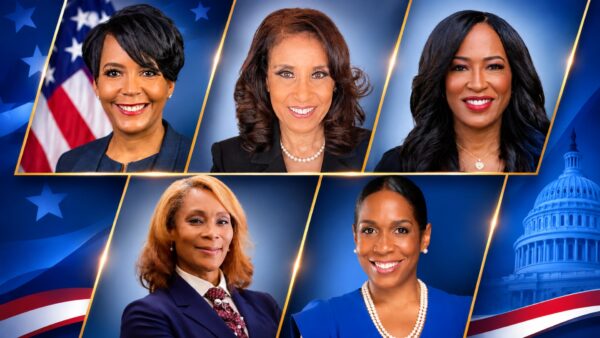
One of the night’s most significant victories came in Georgia, where former Atlanta Mayor Keisha Lance Bottoms became the first Black woman elected governor of a U.S. state.
Bottoms defeated Republican businessman Rick Jackson, becoming Georgia’s first woman governor and the first Black person elected to lead the state. Her victory also ended nearly 24 years of Republican control of the governor’s office.
The milestone came more than three decades after L. Douglas Wilder became the first Black American elected governor of a state in 1989. Although Black men have previously won gubernatorial elections, no Black woman had achieved that distinction until Tuesday.
Bottoms’ election represents a historic breakthrough in a state where Black political participation has played a central role in shaping national elections and where voting rights have remained a major political issue.
Another major milestone came in Illinois, where Lt. Gov. Juliana Stratton defeated Republican Don Tracy to win the U.S. Senate seat being vacated by retiring Sen. Dick Durbin.
Stratton becomes the sixth Black woman to serve in the Senate and the second elected from Illinois, following Carol Moseley Braun, who became the first Black woman elected to the chamber in 1992.
When Stratton takes office in January 2027, she will join Sens. Angela Alsobrooks of Maryland and Lisa Blunt Rochester of Delaware. For the first time in American history, three Black women will serve simultaneously in the U.S. Senate.
Alsobrooks and Blunt Rochester made history in 2024 when they became the first two Black women elected to the Senate during the same election cycle. Their victories established the first period in which two Black women served together in the chamber.
Stratton’s election expands that representation at a time when the Senate will play a central role in shaping federal legislation, confirming presidential appointments and overseeing government agencies.
The election also brought changes to the U.S. House of Representatives.
In Georgia’s 13th Congressional District, Democratic state Rep. Jasmine Clark won the seat previously held by the late Rep. David Scott.
Clark, a scientist and college professor with a doctorate in microbiology, represents a new generation of Black women entering Congress with backgrounds in science, education and state government.
In Illinois, Cook County Commissioner Donna Miller was among the Black women seeking to move from local government into Congress, reflecting a broader group of candidates pursuing higher office after building political careers in their communities.
The election cycle also included congressional candidates Melat Kiros of Colorado and Darializa Avila Chevalier of New York, both of whom defeated incumbent members of Congress in Democratic primaries.
Their campaigns highlighted the growing participation of younger Black women in congressional politics, including candidates with backgrounds in law, education, organizing and public policy.
Beyond Congress, Black women pursued and won positions responsible for administering elections, enforcing state laws and managing government agencies.
In Georgia, former Fulton County Judge Penny Brown Reynolds won the secretary of state election, becoming the first Black woman elected to the position.
Reynolds will oversee Georgia’s elections and several major administrative responsibilities. Her victory places a Black woman in one of the nation’s most closely watched election administration offices.
Democratic state Rep. Tanya Miller also won Georgia’s attorney general race, becoming the first woman to lead the state’s Department of Law.
Miller, a former prosecutor, will oversee the state’s legal affairs and represent Georgia in litigation involving state government.
Georgia voters also elected Lydia Powell as state school superintendent, placing a Black woman in charge of a public education system serving more than 1.7 million students.
While Georgia produced several of the most visible victories, the national significance of the election extends beyond any single state.
Black women entered the 2026 election holding nine statewide executive offices across the country, according to Higher Heights and Rutgers researchers. That figure remained below the previous record of 11, established in 2023.
The candidates seeking those offices included incumbents such as New York Attorney General Letitia James, Massachusetts Attorney General Andrea Campbell, California Secretary of State Shirley Weber and Connecticut Secretary of State Stephanie Thomas.
Their presence illustrates the range of government responsibilities Black women now hold, from election administration and consumer protection to legal enforcement and statewide financial oversight.
The growth in political participation has also extended to state legislatures.
Before the election, 403 Black women served in state legislatures nationwide, just one below the all-time record of 404. Hundreds sought reelection in 2026, while additional candidates competed for opportunities to enter state government.
Those offices frequently receive less national attention than gubernatorial and congressional races, but state lawmakers make decisions affecting public education, housing, criminal justice, health care and economic development.
The expansion of Black women’s political representation reflects decades of organizing and political engagement, particularly through voter registration campaigns, civil rights advocacy and local leadership.
Despite those contributions, Black women have historically faced substantial barriers to winning statewide and federal elections.
The 2026 results demonstrate progress in several areas, although the full national picture will depend on final election results and the number of Black women who ultimately take office in January.
The historical milestones also raise questions about how newly elected leaders will exercise their authority.
Governors oversee state executive agencies and budgets. Senators participate in federal lawmaking and confirmation decisions. Attorneys general enforce state laws, while secretaries of state administer elections and other government responsibilities.
The offices differ in their responsibilities, but the election results place more Black women in positions where they can directly influence public policy rather than participate only as advocates or political organizers.
The victories also highlight generational changes in political leadership, as experienced officials such as Bottoms and Stratton advance to higher office while newer candidates enter Congress and statewide government.
For Black communities across the country, the significance of these elections extends beyond representation alone. The decisions made by these officials will affect issues including educational opportunity, economic development, voting access, public safety and health care.
The November 3 election will be remembered for several historic firsts, including the election of America’s first Black woman governor and the unprecedented presence of three Black women in the U.S. Senate.
But the broader story is the continued expansion of Black women’s participation in American government, from state legislatures and local offices to some of the nation’s highest elected positions.
More than three decades after Carol Moseley Braun broke one of the nation’s most significant political barriers, the 2026 elections mark another chapter in the long history of Black women seeking, winning and exercising political power in the United States.
Join our email list to stay connected.